
Drowning in Data, Short on Insights!

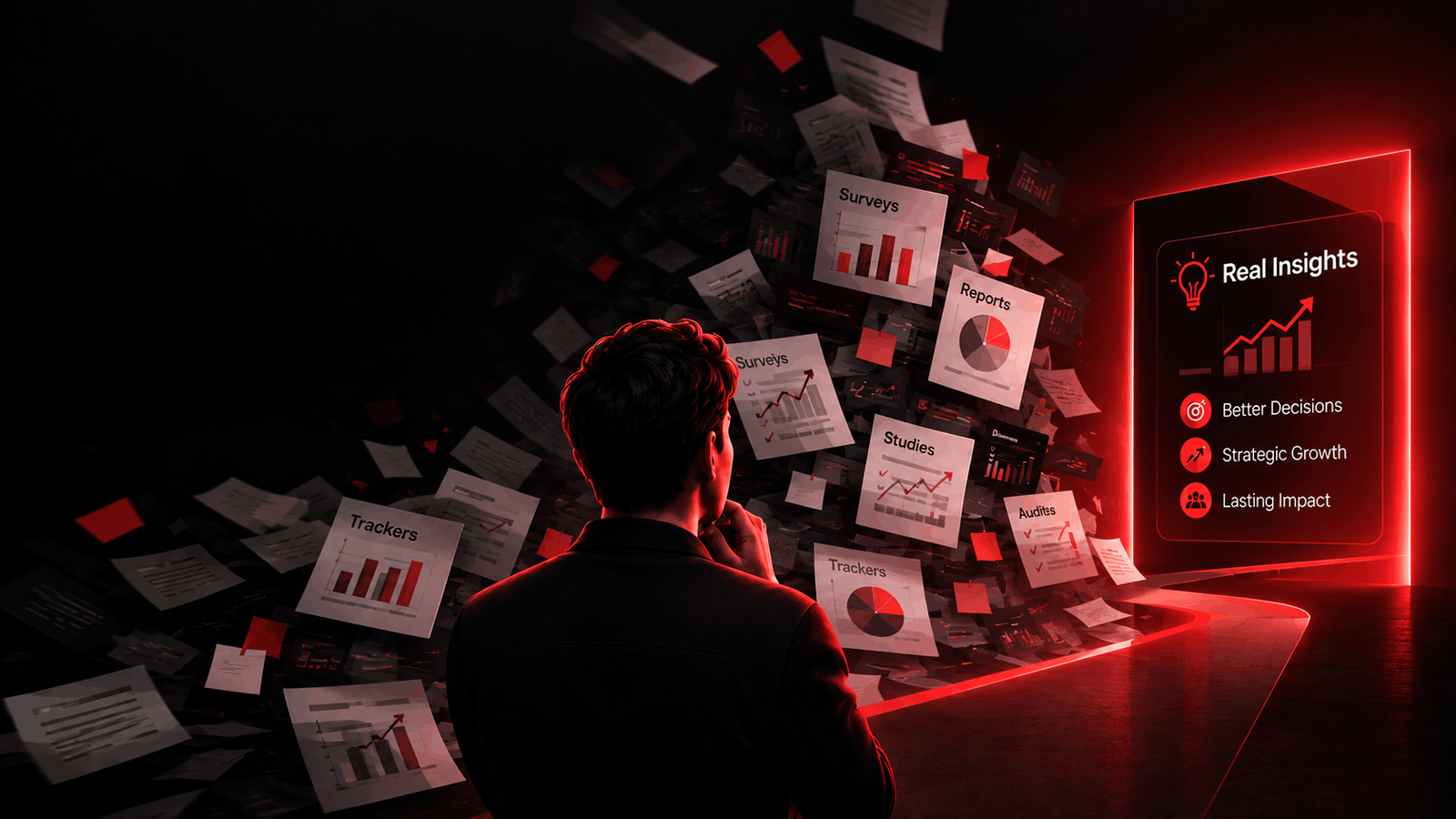
Large corporates manage a relentless stream of tracking studies, commercial audits, and specialized research reports. Yet, despite this abundance of research, a troubling paradox has emerged. We have never possessed more data about our consumers, yet we have never been more uncertain about how to drive sustainable growth. We are drowning in data but starving for insights.
For CXOs, this disconnect is more than an inconvenience—it is a significant operational risk. When billions in organizational strategy, marketing spend and capital allocation depend on consumer understanding, a fragmented, report-heavy view of the market creates a false sense of security while leaving strategic blind spots wide open.
To bridge this gap, organizations must stop treating data accumulation as an end goal and shift their focus to inter-linkages, triangulation, and humanizing the work to answer the "why" rather than just reporting the "what."
The Data Trap: The Illusion of Certainty
Today, a brand can launch a concept test or a pulse survey in hours. While this democratization of research sounds ideal, it has inadvertently shifted the insights function from a strategic advisory capability into a report-generating factory.
This heavy reliance on individual trackers and research on-demand creates distinct blind spots that routinely compromise executive decision-making:
-
Lagging KPIs: Retail market share reports are essential for accountability, but they are inherently backward-looking. They tell a CXO exactly where the business won or lost over the last thirty days. They do not explain why the shift occurred or who is driving it.
-
Continuous Tracking Noise: Continuous brand tracking studies can indicate potential trouble zones when done right, but these are often skewed to legacy brands and mass-market audiences and miss early indicators of trouble in paradise.
-
The Concept & Communication Testing Bubble: Concept tests and communication research measure a consumer's immediate reaction to a simulated proposition but miss a strategic peek into consumer context and changing perceptions in a category.
Moving from data to true insight requires a mutual evolution in how data is synthesized, read, and interpreted.
For Insights Leaders: Knowing the Business to Move from Data to Insights
For the insights specialist, the path forward requires moving away from the role of a research project manager and stepping into the role of a commercial strategist.
1. Cultivate Commercial Acumen
To be relevant to a CXO, an insights leader must understand the P&L, supply chain constraints, and retail margins. When you know the commercial pressures the business is facing, you can filter out 90% of the data noise and focus research efforts purely on the macro levers that drive or destroy enterprise value.
2. Master the Art of Triangulation
The most valuable insights are rarely found at the bottom of a single spreadsheet; they live at the intersection of multiple, seemingly unrelated data streams. Inter-linking various sources turns fragmented data into a cohesive commercial narrative.
3. Answer the "Why" Over the "What"
Focus as much on work that answers the ‘whys’ as on work that reports ‘what’. In most companies, 80-85% of the budget is focused on measuring KPIs or testing marketing-mix. This is where the role of Insights leadership is key in framing the key questions to be answered by research.
For Business Leaders: How to Read and Interpret Data Without Getting Lost
A common corporate refrain is that organizations need to become more "data-driven." In reality, being data-driven without a framework often leads to analysis paralysis.
Business leaders can protect themselves from information overload by adopting a few core principles when consuming data:
Look for the Synthesis, Not the Raw Spreadsheet
Stop asking your insights teams for more data points, bigger sample sizes, or faster dashboards. Instead, demand synthesis. If an insights team presents a 50-slide deck of tracker charts, challenge them to reduce it to three integrated takeaways that impact the business strategy.
Demand the Human Context
Every data point on a tracking wave represents a real person making a hurried choice in a retail store while managing a tight budget or a distracted household. When reviewing data, always ask: What is the underlying human tension driving this number? What fear, desire, or friction explains this sudden dip or spike?
Differentiate Signal from Noise
Not every percentage shift requires a strategy shift. Business leaders must learn to tolerate short-term variance in tracking data and focus instead on framing the right business questions to answer.
From the glossary
- Brand tracking — Brand tracking measures how awareness, consideration and equity shift over time—but without synthesis it becomes continuous noise for CXOs.
- Commercial acumen — For insights leaders, commercial acumen means understanding P&L, margins and constraints so research focuses on levers that change enterprise value.
- Consumer insights — Consumer insights turn evidence about people into decisions about brands, growth and experience—more than another research report.
- Signal vs noise — Not every tracking wiggle is a strategy moment. Signal vs noise is how business leaders stay oriented when data volume outruns judgment.
Related perspectives
-
From Selling Research to Understanding the Problem
Unnayan Ghosh