
From Selling Research to Understanding the Problem

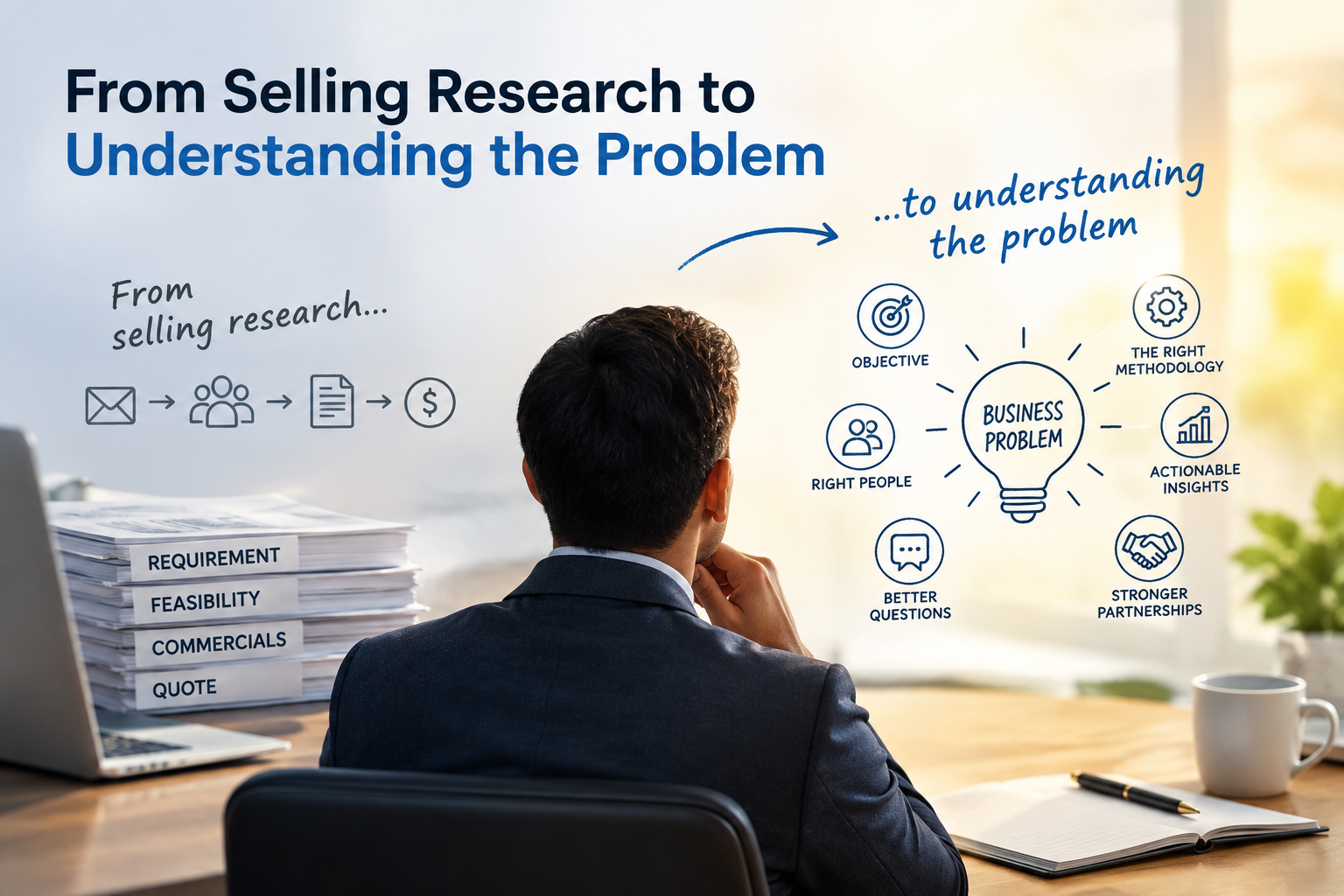
Over the last 15 years, I have worked in sales across the market research industry, and if I combine all the studies, I have been part of winning over the years, the number would comfortably cross 1,000 projects.
But the way I approached sales in the early part of my career was very different from how I look at it today.
I started my career as a BDE, and in those days, I often felt more like a postman than a salesperson. A client would send a requirement, I would forward it to the concerned team, get the feasibility and commercials, and send the quote back to the client. The process was straightforward: receive the brief, circulate it internally, get the price, and respond.
For many years, I thought that was sales.
Eventually, I realised that this approach would only take me so far.
The turning point came around 2022, when I deliberately stepped out of my comfort zone and started engaging more directly with corporate clients. Instead of only asking, “What is the sample size?” or “When do you need the quote?”, I started trying to understand the business objective behind the research.
Initially, most of those conversations went completely over my head.
Clients would talk about customer journeys, business challenges, product adoption, drop-offs, user behaviour, brand perception, conversion, retention, experience, and strategic decisions. For someone who had spent years focusing mainly on commercials and delivery feasibility, a lot of it felt like a bouncer.
But slowly, things started to change.
I began spending more time with researchers. I started asking them basic questions that I probably should have asked much earlier in my career:
What exactly is research? Why do brands invest in it? What do they expect to learn? And, most importantly, what decision are they trying to make at the end of it?
That learning completely changed the way I approached clients.
I realised that good research does not begin with methodology.
It begins with understanding the mindset of the client.
Before thinking about whether a study should be qualitative or quantitative, online or offline, CATI or CAWI, IDIs or FGDs, the first job is to understand the problem that the client is trying to solve.
Because unless you can put yourself in the client’s shoes, you will never fully connect with their thought process.
A research brief may say one thing, but the actual business problem behind it could be very different.
A client may ask for a usability study, but the real concern could be conversion.
They may ask for a brand study, while the real question is whether their positioning is still relevant.
They may ask for customer interviews, but what they actually need is confidence before making a product or investment decision.
That is why I believe understanding the objective is more important than jumping immediately into execution.
Once you understand the problem deeply enough, you are also in a better position to challenge the brief constructively.
Sometimes the client may be thinking in one direction, but you may feel that the proposed approach will not fully answer the business question. That is where the role of a research partner becomes important.
You should be able to say:
“I understand what you are trying to achieve, but perhaps there is another way of looking at this.”
That is not about disagreeing with the client. It is about adding value.
Once the objective is clear, the rest of the research design begins to fall into place.
The next question becomes:
Who do we actually need to speak to?
What should their profile be?
What demographics matter?
What behaviour should qualify them?
What experiences should they have had?
What questions do we need to ask them?
And then, only after all of this, comes the methodology:
What is the best way to uncover the answer?
Sometimes it is qualitative.
Sometimes it is quantitative.
Sometimes it is both.
Sometimes 10 deeply considered conversations can answer the question better than 1,000 survey responses.
And sometimes you need scale before you can confidently make a decision.
The methodology should serve the business problem — not the other way around.
Once the research is complete, the final challenge is equally important: articulating the insights.
Data on its own is not an insight.
A transcript is not an insight.
A chart is not an insight.
The real value lies in connecting all the evidence, understanding what it means, and presenting it back to the client in a way that reflects the question they originally came to you with.
For me, that is when the real test happens.
When a client sees the final report and feels:
“Yes. They understood what I was trying to solve.”
That moment matters more than any methodology slide or sample number.
Because when your interpretation of the problem matches the client’s reality, you stop being just another vendor.
You become a research partner.
And in my experience, that is when clients stay with you.
From the glossary
- Brand tracking — Brand tracking measures how awareness, consideration and equity shift over time—but without synthesis it becomes continuous noise for CXOs.
- Commercial acumen — For insights leaders, commercial acumen means understanding P&L, margins and constraints so research focuses on levers that change enterprise value.
- Consumer insights — Consumer insights turn evidence about people into decisions about brands, growth and experience—more than another research report.
- Triangulation — Triangulation means reading multiple, independent data streams together so a CXO gets a commercial narrative—not a pile of disconnected trackers.
Related perspectives
-
Drowning in Data, Short on Insights!
Ruchira Jain